Curved

26 products
26 products
Sale
Quick view


Sale
Quick view


Sale
Quick view


Sale
Quick view


Sale
Quick view


Sale
Quick view


Sale
Quick view


Sale
Quick view


Sale
Quick view


Sale
Quick view


Sale
Quick view


Sale
Quick view


Curved Floating Shelves and Organic Wooden Wall Decor
A curved floating shelf changes a room in a way a straight one cannot: the eye follows the arc instead of stopping at a corner. This collection gathers every EWART WOODS piece built on an organic, flowing line — curved wall shelves, wave-shaped bathroom pieces, sculptural plant stands and desk objects — all made by hand in our workshop in Latvia. The curves here are not cut out of a board; they are laminated in, layer by layer, which is why they stay curved. Start with the original Wave floating wall shelf or the slimmer Thin Wave, then build the wall from there.
What our customers say
AI-generated summary of recurring themes across real customer reviews of the products in this collection — not individual quotes.
- The curve is what people notice first. Reviewers describe these pieces as sculptural and unusual, and repeatedly say the shape looks better in person than in photographs.
- The mount genuinely disappears. Buyers point out that no hardware shows from above or below, so a curved shelf reads as a line drawn on the wall rather than an object bolted to it.
- Finish quality comes up again and again. The satin-smooth surface and the way the layered wood follows the curve are the two details customers mention most.
- Installation is straightforward with the supplied hardware. Screws and several plug types are in the box; most people hang a shelf without a second trip to the hardware store, though a long shelf is easier to level with two pairs of hands.
- Packaging survives long journeys. Customers across Europe and North America comment on how carefully the curved pieces are boxed.
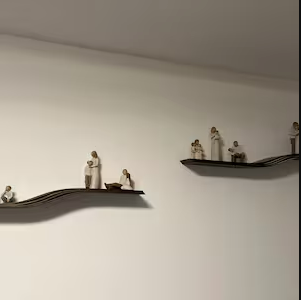
★★★★★
"A really beautiful curved floating wall shelf, fully meets our expectations. Excellent customer service, we received help immediately."
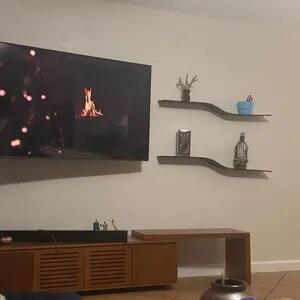
★★★★★
"The shelves are absolutely beautiful! The design is elegant and unique, adding a modern touch to my living room. The shelves are sturdy (see photo — just testing the weight capacity) and well-made. I ordered the 115 cm in 'wenge,' and it looks fantastic. Highly recommend!"
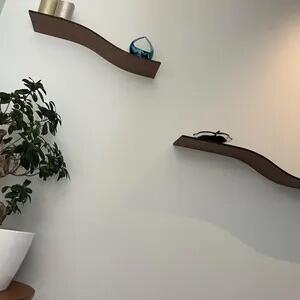
★★★★★
"We ordered the walnut shelves (1 x 90 cm, 1 x 60 cm) for above in the hallway and they are very pretty! We are amazed by the craftsmanship, high quality and beauty of the shelves. The layered wood is very beautifully done. Installation was very easy and included were the right screws and 3 types of plugs. Also great is that the mounting system is not visible anywhere, not from the top and not from the bottom of the shelves, the shelves really seem to be floating on the wall, amazing."
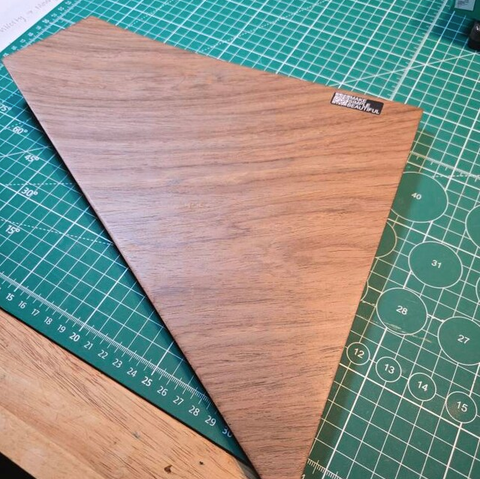
★★★★★
"Repeat customer. High quality. Nice packaging to protect the shelf. We like it."
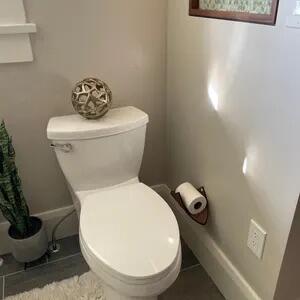
★★★★★
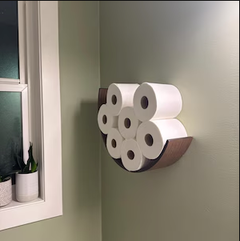
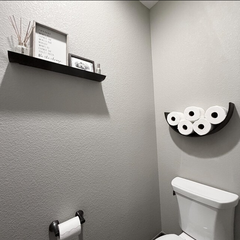
"This is a very well made and interesting toilet paper holder. We installed it lower than toilet seat."
★★★★★
"Really well built curved floating shelf, easy to install and looks great!"
★★★★★
"Very nice wood floating curved wall shelf, great quality and it fits perfectly in our living room."
★★★★★
"How everyone doesn't have this is beyond me. It saves space from the closet and is such a delicate piece that adds an artistic touch to an everyday need. If you position this piece on an angle in a corner you can stack the toilet rolls even higher and in number."
★★★★★
"Exactly as pictured. Fits perfectly in the bathroom and is also very practical, as it's easily accessible. I can wholeheartedly recommend this product."
★★★★★
"The shelf is as described. It arrived quickly and well packaged."
How a curved wooden shelf is actually made
Every piece in this collection is made to order in our own workshop in Latvia, in the European Union. There is no third-party factory in the chain, which is why the same hands appear in the reviews as in the workshop stories on our blog.
The curve is the whole engineering problem, and there are three ways to solve it. You can saw an arc out of a wide solid board — fast, but it leaves short grain at the thin points, so the shelf becomes fragile exactly where it should be strongest. You can steam-bend a solid piece — but solid wood has a memory, and over years it tries to return towards straight. Or you can build the curve out of the material itself, which is what we do.
Our curved shelves are made by laminating thin layers over a shaped form: the sheets are glued, clamped onto the curve and pressed until the adhesive cures. Once it has, the arc is no longer a shape held under tension — it is the shelf's natural resting state. The body is then faced with real wood veneer (koka finieris) in oak, ash, cherry, walnut or wenge, with the interior finished in matte white. This is the honest reason we do not use a single wide solid board for a curved shelf: across a 116 cm span, solid wood moves with the seasons and will eventually cup, split or spring back, while a laminated body stays flat, keeps its line and does not twist or straighten out over time.
After assembly each piece goes through an extended staining and finishing sequence, sanded back between coats, until the surface reaches the satin-smooth finish reviewers keep mentioning. Larger shelves carry a hidden steel T-fixing concealed inside the body; screws and several types of wall plugs — for drywall and for concrete or timber walls — are supplied, together with an illustrated mounting instruction. Solid wood, metal and brass-toned details are used where a design calls for them, on plant stands, shoe racks and tables.
Because the work is handmade, we say so plainly: dimensions can vary by a few millimetres, and the depth and position of a curve differ slightly from piece to piece. Grain and tone vary too, since the wood is natural rather than printed. Every order also plants a tree — one order, one tree — as part of our reforestation commitment.
Curved design, and the rooms it belongs in
The move away from the hard right angle is the clearest interior shift of the last few years, and 2026 has only pushed it further: curved sofas, arched mirrors, rounded plaster edges, soft-cornered joinery. A curved wall shelf is the least expensive way into that language, because it works on the one surface most rooms have too much of — bare wall. Where a rectangular shelf underlines a room's existing geometry, an organic curve interrupts it, and that single interruption is usually enough to make a wall look designed rather than filled.
The vocabulary across this collection is deliberately narrow: an arc instead of a corner, a thin edge, no visible fixings, and wood tone doing the colour work. That restraint is why these pieces read correctly in very different interiors — Japandi, warm minimalism, organic modern, mid-century revival, quiet luxury and classic Scandinavian rooms all accept a curved oak shelf without argument.
In a living room, a run of curved shelves replaces a bulky unit and gives the wall back to the room; the S-shape shelf and the circular shelf set are made for that kind of composition. Bathrooms are where the collection is quietly at its best: a wave-shaped toilet paper holder and a matching ledge turn storage into decor. Hallways take a curved shoe rack, awkward corners take the Corner Shelf Edge, and a desk gets the curved monitor stand. If you are furnishing a whole wall, the wider shelves collection uses the same finishes, so pieces bought months apart still belong together.
Who buys it: people who have already tried the straight shelf and found it too plain; renovators and renters who want one sculptural object rather than more furniture; plant people, book people, and anyone who has spent an evening looking at organic-shaped interiors online and wanted the real, handmade version of it.
Available wood finishes

- Oak — pale, even-grained and unshowy; the safest choice for a strong shape.
- Ash — the lightest of the five, open-grained, keeps a curve looking weightless.
- Cherry — warm reddish-brown that deepens gently with age.
- Walnut — deep chocolate brown; the contrast choice against white walls.
- Wenge — near-black and graphic, which turns a curve into a drawn line.
Selected designs are also made in a matte white finish, and some pieces add powder-coated or brass-toned metal details.
Frequently asked questions
Will a curved shelf lose its shape or straighten out over time?
No. The curve is not forced into a finished board and held there — it is built into the piece. Thin layers are glued and pressed over a shaped form, and once the adhesive has cured the arc is the material's own resting state, with no stored tension trying to pull it back. That is exactly why we do not saw a curve out of one wide solid board or steam-bend a solid piece: both keep a memory of straight and both move with humidity. A laminated, veneered body stays flat, holds its line, and does not twist or unbend across a 116 cm span.
What are the curved shelves actually made of?
A laminated, dimensionally stable core faced with real wood veneer in oak, ash, cherry, walnut or wenge, with a matte white interior. Veneer over a stable core is a deliberate engineering choice for curved work rather than a cost saving. Other pieces in the collection — plant stands, shoe racks, jewellery holders and tables — use solid wood, metal and brass-toned details where the design calls for it. The exact material is listed on each product page.
Are the brackets visible, and is a curved shelf harder to mount than a straight one?
No brackets are visible from any angle, and mounting is no harder. The larger shelves use a concealed steel T-fixing inside the body, which is why reviewers describe them as genuinely appearing to float. Screws and several types of wall plugs — drywall, and concrete or timber wall — are supplied with an illustrated instruction guide. Most customers hang a shelf in under half an hour. On plasterboard, find the studs or use the supplied anchors, and a second person makes levelling a long shelf considerably easier.
How much weight can a curved floating shelf hold?
Enough for a full row of books, which several reviewers have tested and photographed. The real limit is set by your wall, not by the shelf: a fixing into concrete or into a timber stud will always carry more than one into hollow plasterboard. Load capacity varies by length and model, so the figure for each piece is given on its product page — and if you are planning something heavy, message us with the wall type and we will tell you honestly whether it will hold.
Which wood finish suits a curved shape best?
Light woods soften the shape, dark woods sharpen it. Ash and oak let the curve blend into a bright wall and feel calm and weightless, which suits bedrooms and small rooms. Walnut and wenge do the opposite: against a pale wall they turn the arc into a graphic line, so the shelf becomes the focal point of the room. Cherry sits between the two, adding warmth without going dark.
Can I combine several curved pieces into one wall composition?
Yes, and most of the collection is designed for it. Shelves of different lengths in the same finish can be staggered vertically, and curved pieces can be mirrored so the arcs answer each other rather than repeat. Since we keep the same finish palette across shelves, bathroom pieces, plant stands and desk objects, you can start with one shelf and add to the wall later without a mismatch.
Where is everything made, and what do you do about sustainability?
Every piece is made by hand in our own workshop in Latvia, in the European Union — there is no third-party factory in the chain. For every order placed we plant a tree, supporting reforestation to give back more than we take. Pieces are made to order rather than mass-produced into a warehouse, which keeps waste and overproduction down, and they are packed carefully enough that reviewers regularly comment on the boxing after transatlantic shipping.